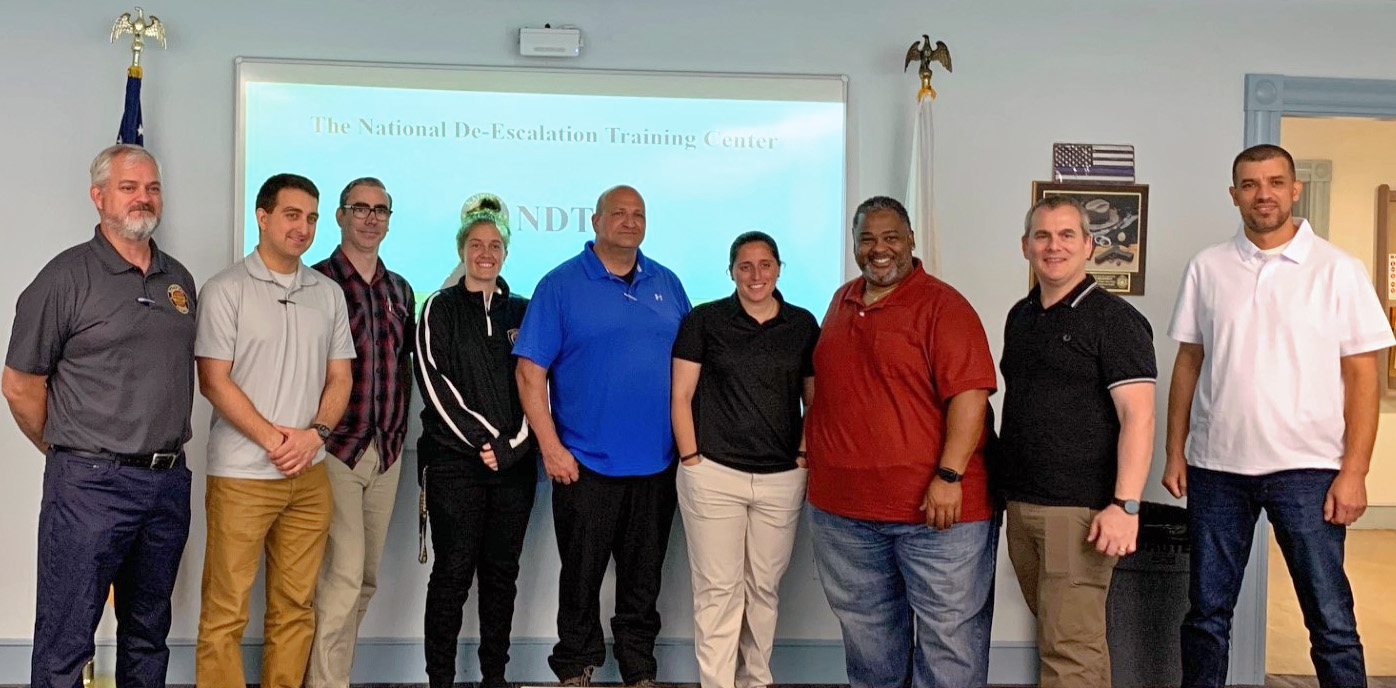
BURLINGTON – Chief Thomas P. Browne is pleased to report that the Burlington Police Department had five officers graduate from a five-day de-escalation training course provided by The Center for Advanced Policing at the University of New Haven in Connecticut.
The Center for Advanced Policing at the University of New Haven in Connecticut is part of the National De-Escalation Training Center (NDTC), which received a $1 million grant from the U.S. Department of Justice’s Community Oriented Policing Services (COPS) Office to provide free de-escalation training to any police agency in the northeast United States.
The Train the Trainers course was a five-day training session that led to five Burlington Officers and two Somerville Police officers being certified to provide the NDTC’s De-escalation Principals and Practice Course to other officers. It was the first such course taught in the Commonwealth of Massachusetts. The course was taught at the Burlington Police Station.
The Burlington Police Officers who participated and graduated from the course are Lt. Glen Mills, Sgt. Matthew Creamer, Officer Stephen Papagno, Officer Nikolas Saledas and Officer Jillisa Smith.
All five officers are now certified and able to teach the course, which covers best practices in de-escalation including procedural justice, correct de-escalation language, officer adjustments for varying threat stages and environments, body language, conflict management, recognizing mental health and disability issues, and means to adjust interactions based upon rapid personality identification. Also included are lessons on de-escalation and prevention of escalation while maintaining professionalism, respectfulness, and self-control, particularly if insulting or disrespectful language and behavior are present.
“Through its Center for Advanced Policing, the University of New Haven is helping to provide critical de-escalation training for local law enforcement, helping them make a difference in their communities while promoting research and best practices,” said Lisa Dadio, Director of the Center for Advanced Policing at the University of New Haven. “We are grateful to our law enforcement partners throughout the Northeast for welcoming us into their agencies to deliver this important training to enhance the relationship between the law enforcement profession and the communities they serve.”
“We are very grateful for the opportunity to send five officers to this free and very important training thanks to the National De-Escalation Training Center,” said Chief Browne. “This training has prepared and enabled our officers to train their colleagues in de-escalation techniques, which furthers our ongoing goal of improving our department’s service to those suffering from mental illness and those who are in crisis.”
For more information on the NDTC, visit: https://ndtccenter.com/about.
Discover more from John Guilfoil Public Relations
Subscribe to get the latest posts sent to your email.